Starting a business often comes with tight budgets and the need to make strategic decisions. One crucial choice is selecting the best cloud hosting provider to support your website or application. For startups, affordability and performance are key factors. This guide will explore the best affordable cloud hosting options for startups, helping you make an informed decision.
Why Cloud Hosting Matters for Startups
Discover related topics
by Indotex DigitalCloud hosting offers scalability, flexibility, and reliability, making it a preferred choice for startups. Unlike traditional hosting, cloud hosting utilizes multiple servers, ensuring better uptime and performance. For startups, the ability to scale resources as the business grows is invaluable. Furthermore, many cloud hosting providers offer pay-as-you-go pricing models, helping startups manage costs effectively.
Key Features to Look for in Cloud Hosting
When choosing a cloud hosting provider, consider the following features:
- Cost-Effectiveness: Look for providers with transparent pricing and plans that fit your budget.
- Scalability: Ensure the platform can scale resources up or down based on your needs.
- Performance: Check for fast load times, high uptime guarantees, and optimized infrastructure.
- Security: Opt for providers that offer robust security features like SSL certificates, firewalls, and backups.
- Ease of Use: For startups with limited technical expertise, a user-friendly interface is essential.
- Customer Support: Reliable 24/7 customer support ensures that issues are resolved quickly.
Top Affordable Cloud Hosting Providers for Startups
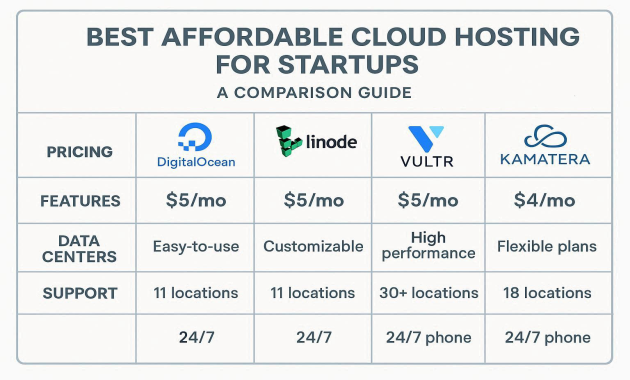
Here’s a comparison of some of the best affordable cloud hosting providers tailored to the needs of startups:
1. DigitalOcean
Overview: DigitalOcean is known for its developer-friendly platform and straightforward pricing. It offers scalable solutions suitable for startups.
Key Features:
- Transparent pricing starting at $5/month.
- Droplets (virtual machines) optimized for performance.
- Managed Kubernetes for containerized applications.
- Developer-friendly tools and integrations.
Pros:
- Cost-effective for small to medium workloads.
- Excellent documentation and tutorials.
Cons:
- Limited managed services compared to competitors.
2. Linode (now Akamai Cloud)
Overview: Linode provides high-performance cloud hosting with a focus on simplicity and affordability.
Key Features:
- Plans starting at $5/month.
- SSD storage for faster performance.
- Comprehensive API support.
- DDoS protection included.
Pros:
- Competitive pricing.
- Reliable infrastructure with a focus on small businesses.
Cons:
- Fewer advanced features compared to larger providers.
3. Hostinger
Overview: Hostinger offers one of the most budget-friendly cloud hosting solutions without compromising on performance.
Key Features:
- Plans starting at $9.99/month.
- Free SSL certificate and domain.
- Daily backups included.
- 24/7 customer support.
Pros:
- Affordable entry-level plans.
- Beginner-friendly dashboard.
Cons:
- Limited scalability for larger applications.
4. AWS (Amazon Web Services)
Overview: AWS is a leading cloud hosting provider offering a wide range of services. Its Free Tier makes it accessible for startups.
Key Features:
- Free Tier includes 750 hours/month of EC2 usage for 12 months.
- Auto-scaling and load balancing.
- Global infrastructure for low-latency performance.
- Comprehensive security features.
Pros:
- Highly scalable and versatile.
- Extensive service catalog.
Cons:
- Pricing can be complex for beginners.
5. Google Cloud Platform (GCP)
Overview: Google Cloud Platform is known for its robust infrastructure and AI/ML integrations.
Key Features:
- Free Tier includes $300 in credits for new users.
- Managed Kubernetes Engine.
- Global network for high-speed performance.
- Advanced analytics and data tools.
Pros:
- Excellent for data-intensive startups.
- Scalable and reliable.
Cons:
- Higher learning curve for beginners.
6. Microsoft Azure
Overview: Microsoft Azure is another top contender, offering a wide array of services for startups and enterprises alike.
Key Features:
- Free account with $200 in credits for the first month.
- Integration with Microsoft tools like Office 365.
- AI and IoT capabilities.
- Strong focus on security and compliance.
Pros:
- Ideal for startups using Microsoft’s ecosystem.
- Highly secure and compliant.
Cons:
- Slightly more expensive for small-scale projects.
7. Vultr
Overview: Vultr is a lesser-known provider offering affordable and customizable cloud hosting.
Key Features:
- Plans starting at $2.50/month.
- High-performance SSD storage.
- One-click app installations.
- Global data center locations.
Pros:
- Very affordable entry-level plans.
- Simple and user-friendly interface.
Cons:
- Limited managed services.
How to Choose the Best Option for Your Startup
Selecting the right cloud hosting provider depends on your startup’s specific needs and budget. Here are some tips:
- Define Your Requirements: Assess your expected traffic, storage needs, and technical capabilities.
- Start Small: Opt for a provider with low-cost entry plans and the ability to scale as you grow.
- Test Free Tiers: Many providers offer free trials or credits to help you evaluate their services.
- Prioritize Support: Ensure the provider offers reliable customer support to address issues promptly.
- Consider Long-Term Costs: Evaluate the provider’s pricing structure to avoid unexpected expenses.
Conclusion
Choosing the best affordable cloud hosting for your startup is a critical decision that can impact your business’s growth and success. Providers like DigitalOcean, Linode, Hostinger, AWS, GCP, Microsoft Azure, and Vultr offer diverse options tailored to different needs and budgets. By understanding your requirements and comparing features, you can find a solution that delivers the best value for your startup.
Investing time in selecting the right provider now can save costs and headaches in the future, ensuring that your startup has a strong and reliable foundation for growth.